


The lump under your pet's jaw may well be a swollen lymph node, but salivary glands, cysts, abscesses, fatty masses, and skin tumors all occur along the same stretch of neck and can feel surprisingly alike. Lymph nodes do have tells: they sit in a predictable spot just below the angle of the jaw and come in pairs. One side or both is a detail that matters to us, because a single swollen node often points to a problem nearby, such as a bad tooth, while the pair together can mean something bodywide, including lymphoma. Feel alone cannot tell you which of those it is or rule out the look-alikes with any certainty, but a quick needle sample can do both.
Finding a lump on your pet is worrying, and you should not have to guess at it for weeks. At Milford Animal Hospital in Milford, PA, we will examine the swelling, check its partner on the other side, and take a needle sample to find out what it actually is, all under one AAHA-accredited roof. If the sample points past a local infection, our in-house ultrasound and digital imaging, read by board-certified specialists with results the next day, can show what is happening deeper in the body. A lump that has been sitting there for months still deserves that look, and a new one should be seen within a day or two, so request an appointment and let us sort it out with you.
Before You Wait and See on That Lump
- One enlarged node usually points to a problem close by, like a cracked tooth or an infected scratch, while several enlarged at once suggests something affecting the whole body.
- Infection, immune-mediated disease, and cancer can all swell a lymph node, and they feel identical under your fingers.
- A fine needle sample takes seconds, rarely needs sedation, and is the fastest way to separate a reactive node from lymphoma.
- Dogs whose nodes balloon while they still feel great are the ones we want to see soonest, so a new swelling is worth a call within a day or two.
What Are Lymph Nodes, and What Do They Do?
Lymph nodes are immune checkpoints. Each one filters the fluid draining out of a particular region of the body, traps bacteria, viruses, and abnormal cells moving through it, then organizes the immune response against whatever it caught. A node you can suddenly feel is a node that has switched on.
Five lymph node locations sit close enough to the skin for your fingers to find: behind each knee, in the groin, inside the armpits, ahead of the shoulder blades, and beneath the jaw. The rest stay deep in the chest and belly, where only imaging reaches them.
In a healthy dog, the ones below the jaw feel like a grape at most. In a cat they're closer to a pea, soft and easy to miss entirely. We check the same set of spots at every routine wellness exam, which is how a change gets caught early.
Why Do Lymph Nodes Swell in Dogs and Cats?
A node swells because it's responding to something: an infection draining into it, an immune system in overdrive, or cancer cells multiplying inside it. One big node points to trouble in the territory it drains, while several at once suggests something bodywide.
Texture adds a little. A reactive node is often soft, a little tender, and still slides under the skin when you press it. A node packed with cancer cells tends to feel firm, painless, and rooted in place. None of that is diagnostic on its own, but it shapes how fast we move and which test comes first.
Could an Infection Be Behind It?
Infection is the most common answer, and it's the one we hope for. A single enlarged node under the jaw often traces back to a fractured tooth, an abscessed root, or a scratch on the muzzle. When the problem is in the bloodstream instead, every node we can reach comes up together.
- Parasites: Toxoplasmosis, a heavy intestinal worm burden, and a bad flea or mite infestation all keep nodes working overtime.
- Ticks and what rides on them: Northeastern Pennsylvania is deer tick country. Lyme disease tends to appear weeks after the bite as shifting lameness, fever, and enlarged nodes. Ehrlichia and Anaplasma travel on those same ticks and push nodes up while platelet counts quietly fall. A tick panel and a blood count usually run together for that reason.
- Bacteria from water and wildlife: Leptospirosis comes from puddles, standing water, and wildlife urine, inflaming nodes before it starts damaging kidneys and liver. Mycobacteriosis is rarer and shows up mostly in hunting cats as stubborn skin lesions with node changes.
- Fungus from the soil: Blastomycosis and histoplasmosis live in river valley soil west and south of us, and a traveling dog can come home with a cough, weight loss, and big nodes. Valley fever does the same after a trip to the desert Southwest. Aspergillosis turns up in every region and often starts in the nose before the jaw nodes react.
- Retroviruses in cats: Feline immunodeficiency virus and feline leukemia virus each keep a cat's immune system on a permanent slow burn, and widespread node enlargement is a common finding in carriers.
Is It Lymphoma?
Canine lymphoma is the classic cause of nodes that balloon over a week or two while the dog still eats, plays, and gives no other sign that anything is wrong. Big swelling in a dog who feels fine is what brings most families through the door. Roughly one in fifteen dogs born today will face this disease, and lymphoma risk in Golden Retrievers climbs to about one in eight.
Cats tend to present differently. Feline lymphoma favors the intestinal tract over the nodes your hands can reach. Weight loss, vomiting, and a cat picking at meals can be the first sign instead of a lump.
Other tumors reach the nodes as well. A mast cell tumor on the leg or a melanoma in the mouth tends to seed the node draining that area first, which is why we sample the node along with the mass. Plenty of dramatic swellings still turn out to be infection, and the two look the same from the outside.
What About Immune Disease and Vaccine Reactions?
Immune disease and vaccine reactions can both enlarge a node. Immune-mediated hemolytic anemia turns the immune system against a pet's own red blood cells, and nodes swell as part of that overdrive, usually alongside pale gums, weakness, and breathing that looks too fast for the moment. Lupus and immune-mediated polyarthritis take different routes to a similar place, adding fever and shifting joint pain with no infection behind it.
Mild vaccination reactions can puff up the node nearest the injection site for a day or two. That swelling is the body answering the shot the way it should, not a sign of trouble. Anything still enlarged after that gets the same workup as everything above.
What Does the Workup Involve?
The workup starts with our hands and a needle sample from the largest node. Blood work, tick testing, and imaging follow when the cells point past a simple local infection.
What Our Hands Notice First
Palpation narrows things quickly, and the detail that matters most is whether a node's partner on the other side matches it. One hot, tender, mobile swelling with a broken tooth above it tells a very different story than five firm, painless nodes in a dog who feels fine. The first buys us room to treat and recheck. The second moves straight to a sample.
What Happens During a Needle Sample?
Fine needle aspiration pulls cells out of the swollen node in a matter of seconds, using a needle the same size as the one your pet gets for a routine shot. Most pets need nothing more than a chin rub while it happens.
Those cells go onto a slide and under a microscope. Cytology separates a reactive node from an infected one and identifies lymphoma in most dogs, which is often all anyone needs. When the picture is ambiguous, or when confirming a subtype requires intact tissue, a biopsy is the next step, and we can take one here under monitored anesthesia, with a technician watching vitals from induction through recovery.
Which Tests Come With the Sample?
A complete blood count and chemistry panel come next, running in our in-house lab and screening for what a node alone can't show: infection in the bloodstream, low platelets, anemia, organ values drifting out of range. A tick panel goes with it in this part of the country. When lymphoma or a deeper infection is a real possibility, abdominal ultrasound and digital radiographs show us the nodes and organs no hand can reach. Our CT scanner for dogs and cats takes that a step further, providing a full 3D reconstruction that allows us to see tumors or lesions in more detail than X-ray or ultrasound allow. Staging that way decides the plan and sets honest expectations for what comes next. Milford Animal Hospital has a full suite of diagnostic tools the average veterinary clinic doesn’t have access to, with boarded radiology specialists that provide quick and thorough interpretation, so you don’t need to travel to a referral hospital.
What Happens Once the Cells Come Back?
A swollen lymph node gets treated according to what the cells show, never ahead of that answer. Starting an antibiotic or a steroid before that sample is read can blur the picture badly enough to cost weeks.
| What the cells show | Where treatment goes |
| Bacterial infection nearby | Antibiotics, plus fixing whatever started it, usually a bad tooth or a bite |
| Tick-borne infection | Doxycycline for a full course, then repeat blood work to confirm recovery |
| Fungal infection | Antifungal medication carried on for months, with monitoring built in |
| Immune-mediated disease | Drugs that turn the immune response down, followed by a slow taper |
| Lymphoma | Chemotherapy chosen for the subtype, aimed at remission and comfortable months |
| Spread from a tumor elsewhere | Full staging first, then treatment pointed at the primary tumor |
With lymphoma, the subtype driving the disease decides the protocol, because B-cell and T-cell disease respond to different drugs and carry different expectations for how long a remission holds. For most patients we are aiming at remission rather than a cure, and a good one can mean many comfortable months. Some families choose a full protocol; others choose a gentler road focused on feeling well for as long as possible. Both are legitimate. When treatment isn't right for an individual pet, quality-of-life and comfort-focused support is a real plan, not a failure, and we'll talk it through before anyone decides anything.
Can Swollen Lymph Nodes Be Prevented?
Swollen lymph nodes can't all be prevented, and lymphoma in particular isn't preventable. The infectious triggers largely are, though, and they account for a large share of what we see.
- Parasite prevention, year-round: Ticks here are active any month the ground isn't frozen, and the infections they carry are far easier to prevent than to treat. Flea and intestinal worm control does the same quiet work.
- Vaccines matched to the life: Leptospirosis and Lyme protection matter more for a dog exploring the Delaware valley than for one who rarely leaves a porch, and Feline Leukemia matters for cats who go outdoors, so we set the schedule around how your pet spends their days.
- A healthy mouth: Years of low-grade gum disease keep the jaw nodes switched on, and professional dental cleanings with full-mouth radiographs find the bad roots quietly feeding it.
Blood-based screening tests now flag lymphoma months ahead of any change you could feel with your hands. That moves the whole conversation earlier, back when more options are still on the table. For a middle-aged Golden Retriever or Boxer, that's worth raising at a routine visit rather than waiting for a lump.
How Soon Should a Swollen Node Be Seen?
A swollen node that is new, or clearly bigger than it was last week, should be seen within about 48 hours. Anything interfering with breathing or swallowing is a same-day problem. A swelling that's held the same modest size for months can wait for a scheduled slot this week, though it still needs a sample once you're here.
| Urgency | Signs that fit |
| Right away | Noisy or labored breathing, gagging, pressure on the throat, collapse, pale gums, or a pet gone suddenly weak and off food |
| Inside 48 hours | A node that just appeared, one that grew over a few days, several up at once, or swelling with fever, lethargy, or weight loss |
| Later this week | A node that has held steady for weeks, a small left-right difference you found at home, or swelling in a pet who seems fine |
We handle urgent and emergency care during our open hours, so a same-day worry during the week has somewhere to go; once we've closed for the evening, or on a Sunday, a true emergency should go straight to the nearest veterinary ER. When you can't tell which row your pet belongs in, give us a call and let us help you sort it out.
How Do I Check My Pet's Lymph Nodes at Home?
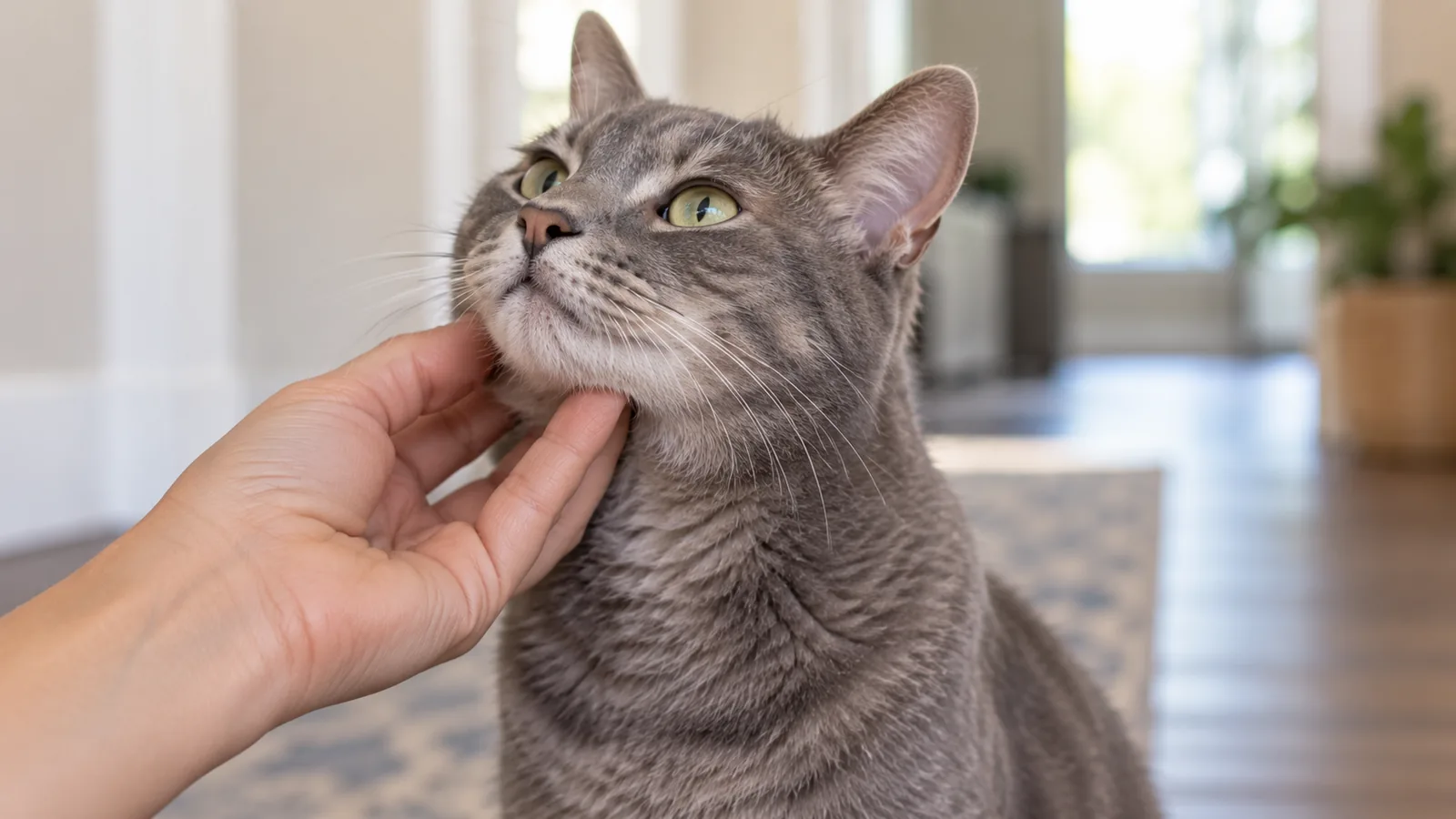
Checking your pet's nodes at home works best about once a month, with your pet relaxed and preferably half asleep. Run your fingertips along the jawline, the points of the shoulders, the armpits, the inner thighs, and the back of each knee. You aren't measuring anything. You're learning what normal feels like on this particular animal.
Compare left to right as you go. A matched pair is reassuring; a clear difference between sides is the thing worth a call. The whole check takes about a minute.
A few instincts make things worse. Don't squeeze or repeatedly massage a swollen node, since that inflames the tissue and can make a sample harder to read. Skip warm compresses, and never try to drain or lance a swelling at home. Don't reach for leftover medication from a past illness either, especially a steroid, because even a few doses can scramble the cytology and delay a lymphoma diagnosis by weeks.
Questions We Hear About Swollen Nodes
Do Swollen Lymph Nodes Ever Shrink Without Treatment?
Swollen lymph nodes do sometimes shrink without treatment. A reactive node answering a minor infection often settles once that infection clears. The catch is that lymphoma doesn't shrink while you wait, and the outside of a swelling won't tell you which one you're looking at. A few days of watching is reasonable for a small change in a pet who feels great. A month of watching is how treatable problems become complicated ones.
Is lymphoma painful for dogs and cats?
Lymphoma usually isn't painful for dogs and cats early on, and the enlarged nodes themselves rarely hurt, which is part of why this disease slips past so many families. Most dogs are eating, walking, and behaving completely normally at diagnosis. Discomfort tends to arrive later, from swelling large enough to press on the airway or esophagus, or from the illness that follows as things progress. Cats with the intestinal form more often show nausea, poor appetite, and weight loss than anything that looks like pain.
What else could the lump be if it isn't a lymph node?
If the lump isn't a lymph node, several other structures in that same stretch of neck could explain it. Salivary glands sit just forward of the jaw nodes and can swell or form a fluid-filled mucocele. Abscesses from a bite or scratch are common in cats, and fatty masses, cysts, and skin tumors all occur along the same stretch of neck in dogs. A few of them feel almost exactly like a node under your fingers, which is the whole reason a needle sample exists.
From a Lump Under the Jaw to a Real Answer
A needle sample usually closes the gap between a lump that could be anything and a plan you can act on, and earlier evaluation keeps more doors open, whether that means antibiotics for an infected tooth or an honest conversation about lymphoma while your dog still feels good. If you've found a lump you’re worried about, book a visit at Milford Animal Hospital in Milford, PA. If you're not sure it's worth an appointment yet, send us a message and ask, because we'd much rather check a lump that turns out to be nothing than have you wait and worry.



Leave A Comment