

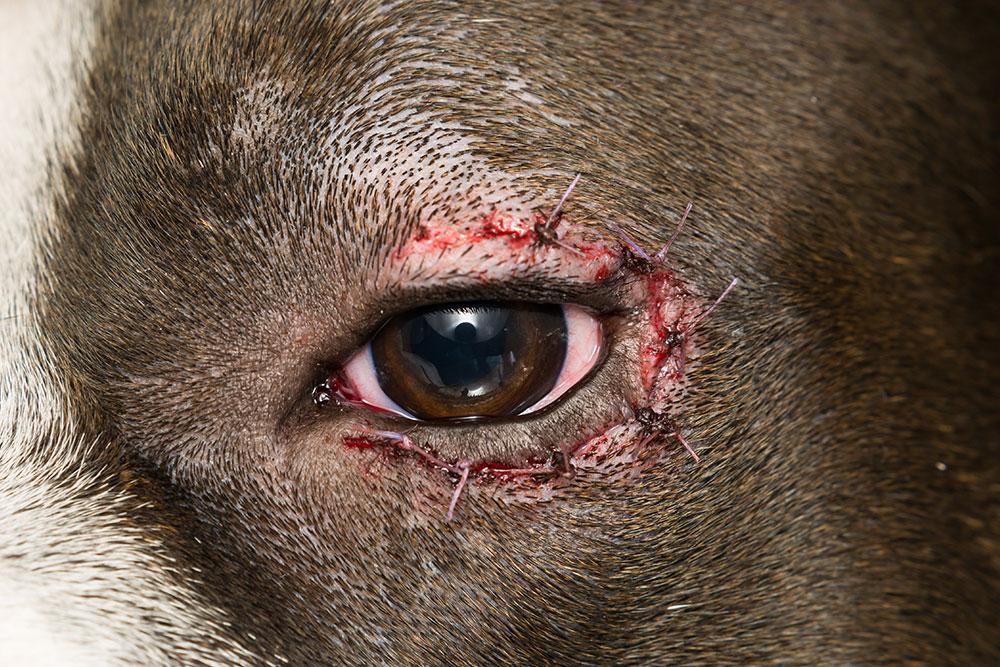
If your dog or cat has been squinting, tearing excessively, or pawing at their face, the problem may not be an eye infection or allergies. It could be an eyelid condition. Entropion, where the eyelid rolls inward and rubs against the eye surface, and ectropion, where the eyelid droops outward and exposes the inner tissue, are two of the most common structural eyelid problems in pets. Both cause chronic discomfort, and without treatment, they can lead to corneal damage and vision loss.
At Milford Animal Hospital, we bring our AAHA-accredited standards to the care of every patient, and that includes the surgical precision required for eyelid correction. Our surgical capabilities allow us to evaluate your pet’s eyelid anatomy thoroughly and plan the most effective correction. Reach out to us if your pet is showing signs of eye discomfort.
What Entropion and Ectropion Do to the Eye
These two conditions affect the eyelid in opposite ways, but both cause problems that worsen over time without treatment.
Entropion in dogs occurs when the eyelid margin rolls inward, bringing the fur and lashes into direct contact with the cornea (the clear outer surface of the eye) with every single blink. The friction is constant and produces pain, persistent tearing, redness, and over time, corneal scarring and ulceration. Entropion can be hereditary, present from birth, or develop gradually with age.
Ectropion works the other way: the lower eyelid sags outward, exposing the inner eyelid (conjunctival) tissue to air, debris, allergens, and bacteria. Rather than friction, ectropion causes chronic low-grade inflammation and recurrent infection because the eye’s natural cleaning mechanisms no longer function normally.
Some pets develop a combination of both in different parts of the same eyelid, requiring surgical attention to both components. The range of eye conditions affecting eyelid position is broad, and a thorough examination is needed to determine exactly what is present before any correction is planned.
Which Pets Are Most Commonly Affected?
Eyelid disorders are closely tied to genetics and facial anatomy, and vary in onset and severity across breeds.
Breeds commonly affected by entropion:
- Chow Chows, Shar-Peis, and Mastiffs, where heavy skin folds roll the lid inward
- Golden Retrievers, Labrador Retrievers, and Rottweilers
- Bulldogs, Pugs, and French Bulldogs, where flat facial structure causes medial canthal entropion at the inner eye corner
- Basset Hounds, St. Bernards, and Great Danes are prone to ectropion
- Flat-faced cat breeds such as Persians and Himalayans are predisposed to entropion due to their compressed facial structure.
Breed aside, acquired entropion can develop in any pet as a consequence of chronic eye irritation, squinting, or aging. Our wellness plans are a great way to stay ahead of problems. With options including unlimited wellness visits, lab work, and even optional emergency visits all covered with an easy monthly cost, you can be sure your pet’s eye health is properly monitored as they age.
Signs That Your Pet’s Eyes Need Evaluation
Eyelid conditions cause real pain, and the behavioral signs often precede visible physical changes.
Warning signs worth a prompt exam:
- Excessive tearing or watery discharge that keeps returning
- Squinting or keeping one eye partly closed, particularly in brighter environments
- Pawing, rubbing, or scratching at the face or eye
- Visible red or pink inner eyelid tissue at the corners
- Cloudiness or color change on the corneal surface
- Thick or colored discharge or persistent crusting
- A lower lid that visibly droops or an upper lid that appears to roll inward
Signs of eye pain are not always obvious. A pet who has stopped tolerating face touching, avoids bright light, or seems unusually irritable when approached near the head may be experiencing significant ocular discomfort.
The Cost of Waiting
Untreated entropion causes progressive corneal damage. Lash friction produces corneal ulcers, open wounds on the eye surface that can become infected, deepen, and in severe cases threaten vision. Scar tissue from chronic rubbing permanently reduces corneal clarity even after the structural issue is corrected. The longer surgery is delayed, the more secondary damage accumulates and the more complex the outcome picture becomes.
Untreated ectropion leads to recurrent infection and chronic eye discharge as the exposed inner eyelid tissue loses its natural protection.
How We Evaluate Eyelid Problems
Our thorough ophthalmic examination follows a systematic approach.
The diagnostic process:
- Lid position assessment: evaluating where the margin sits relative to the cornea, before and after applying topical anesthetic (which allows the lid to relax to its true structural position)
- Schirmer tear test: measures tear production, since dry eye often coexists with or mimics entropion
- Fluorescein staining: a harmless orange dye reveals corneal ulcers invisible to the naked eye
- Magnified examination: checks for eyelash problems including distichiasis (abnormally positioned lashes) and trichiasis (normal lashes misdirected toward the cornea), which can mimic or compound entropion
- Assessment of facial structure and breed conformation
The information gathered from ocular tests guides whether the problem requires surgery, temporary measures, medical management, or a combination.
Treatment Options
Temporary Eyelid Tacking
Temporary eyelid tacking uses small sutures placed to hold the eyelid in a corrected position. It is used primarily in young puppies whose facial structure is still changing. The goal is to protect the cornea during the developmental period while the final lid position is determined. Some puppies improve adequately with tacking as they mature; others require permanent surgery once growth is complete.
Permanent Surgical Correction
Definitive eyelid surgery is performed once facial structure has matured and the final lid position is established. For entropion, a precisely measured ellipse of skin and tissue is removed to roll the lid margin back into its correct position. For ectropion, the procedure tightens and repositions the drooping lid. The exact technique varies by location and degree of the malposition, species, and individual anatomy.
Surgical precision is critical. Too little tissue removed leaves the original problem; too much creates the opposite condition. This is why the experience and careful planning behind the procedure directly determines the quality of the outcome.
Entropion in Cats
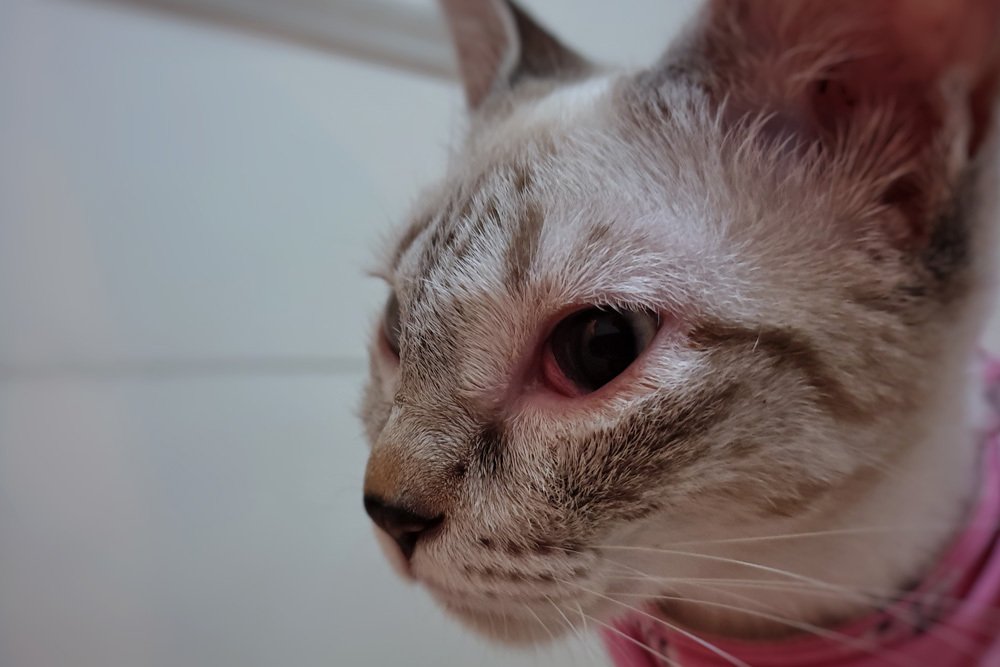
Entropion in cats typically develops differently than in dogs. Rather than presenting at birth as a hereditary condition, feline entropion most often develops later in life, frequently secondary to chronic eye surface disease or as a consequence of prolonged squinting from another cause. In cats, treating the underlying condition is often necessary alongside correcting the lid position, and smaller, more delicate surgical corrections are required.
What Surgery Day Looks Like
Milford Animal Hospital’s surgical suite is stocked with the most up-to-date, medically advanced anesthetic and surgical equipment. We use a surgical laser when appropriate to help decrease bleeding and speed healing, and use individualized anesthetic and surgical plans for each patient.
Pre-surgical preparation includes:
- Pre-anesthetic bloodwork for older pets or those with health conditions
- A discussion confirming the surgical plan and individual anesthetic approach
- Pain medications administered before the procedure begins so pets wake up comfortable
During surgery, heart rate, breathing, blood pressure, and temperature are monitored continuously by our expert surgical technicians. The eyelid is carefully prepared, measured, and sutured with precision by our experienced surgeons.
After surgery, patients go home with written discharge instructions, medications, and specific guidance on the recovery period.
Recovery and Home Care
Normal after surgery:
- Mild swelling and bruising peaking around 24 to 48 hours
- Small amounts of clear discharge as the eye adjusts
- Slight grogginess from anesthesia on the day of the procedure
Call us if you see:
- Rapidly worsening or spreading swelling
- Thick yellow or green discharge
- Any bleeding from the incision site
- Sutures that are loose or missing
Administering eye medications at home can feel intimidating. Our team walks through the technique before discharge, and we encourage questions during recovery rather than struggling in silence.
The e-collar is non-negotiable. Brief periods without it are when incisions are most often disrupted.
The Healing Timeline
- 10 to 14 days: sutures are typically removed at the follow-up appointment
- Weeks 2 to 6: final lid position settles as residual swelling resolves
- Follow-up exams: confirm that healing is proceeding correctly
Most pets show obvious, rapid relief within the first day or two after surgery. The squinting, pawing, and tearing that prompted the visit typically resolve dramatically once the lid is in its correct position.
What Outcomes Look Like
Eyelid surgery performed with proper planning and technique has consistently good outcomes. A lid that sits in its correct position without causing friction or leaving tissue exposed, and an eye that is comfortable and free of ongoing corneal damage, is the achievable goal for most patients.
Factors affecting outcomes include:
- How much secondary corneal damage was present before surgery
- Whether the correction achieves proper lid position without overcorrection
- The pet’s age and facial structure maturity at the time of surgery
- Consistent e-collar use and medication compliance during recovery
Our team follows each case through recovery to ensure the result is what it should be.
Frequently Asked Questions
Can entropion or ectropion come back after surgery?
In most cases, surgical correction is permanent. Minor revision is occasionally needed if healing does not produce perfect symmetry.
Can my puppy have surgery now?
Permanent surgery is generally delayed until growth is complete, typically six months to one year depending on breed. Temporary tacking is used in the meantime to protect the cornea.
How do I know it is an eyelid problem and not allergies or infection?
Recurring symptoms that do not respond to standard treatment, or a visible lid position abnormality, are key signals. Our examination distinguishes between these causes reliably, and treating the wrong problem wastes time your pet’s eye does not have.
Protecting Vision Starts With the Right Evaluation
Entropion and ectropion are painful, progressive, and surgically correctable when addressed with proper planning and technique. The pets who do best are those whose families recognize the signs early and pursue evaluation before secondary damage accumulates. At Milford Animal Hospital, world-class surgical care and the thorough, personal attention of a community practice are a part of every visit.
Reach out to schedule an appointment or contact us if your pet’s eyes have been a concern. We’re here to be your partner for long-term health.


Leave A Comment